What a useful inventory must answer
Imagine a family member finding three hardware wallets and a folder called “Important.” They still do not know which devices matter, whether an exchange holds other assets, or which document is current. A list of account names solves only the first part of the problem.
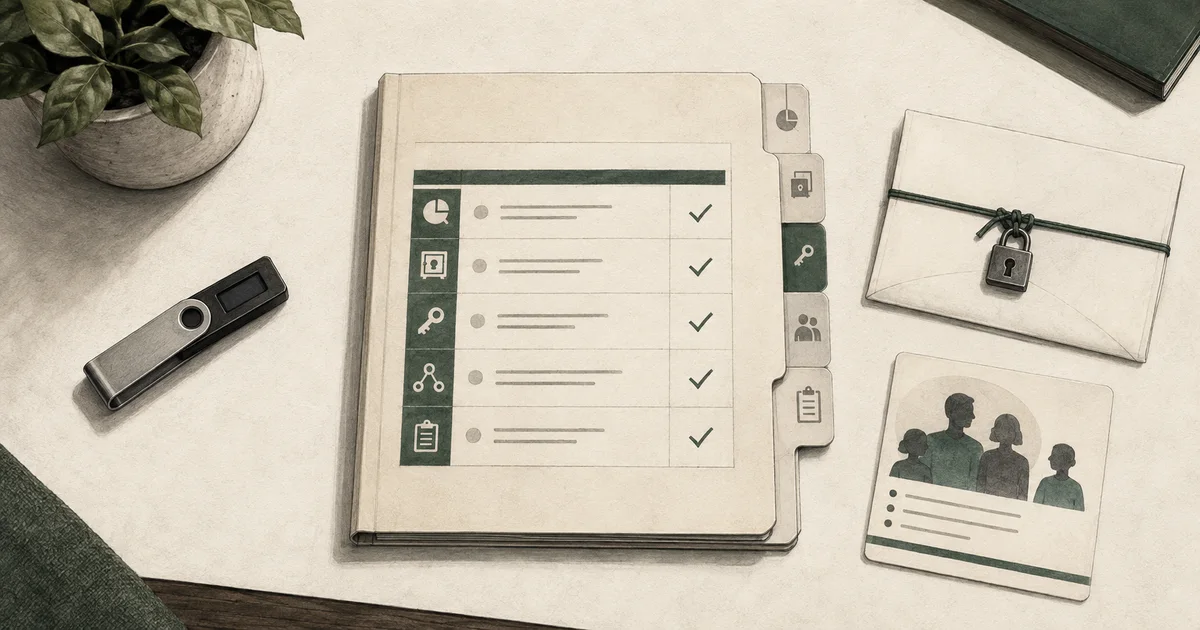
A usable inventory answers four questions for every entry: what is it, which recovery process applies, where does that process start, and who may act? It should also tell the reader when to stop. An adviser’s telephone number is more useful than a vague instruction to “ask someone who understands crypto.”
This template is an organizational tool. Naming someone in a spreadsheet does not make them a beneficiary, executor, or authorized account user. Keep those decisions aligned with your actual legal documents and provider rules.
Download the blank template
Download the digital asset inventory CSV. It opens in a spreadsheet app, requires no registration, and contains blank fields only. You can also copy the table below onto paper.
Complete the file privately. An inventory can expose account relationships and backup locations even without containing passwords. Choose its storage and sharing permissions accordingly; avoid a public link or a shared work folder.
| Field | What to record | What to leave out |
|---|---|---|
| Item ID and label | A stable reference, such as WALLET-A | A label containing a secret |
| Category and custody | Self-custody wallet, exchange, email, cloud, domain | A vague label such as “crypto” |
| Network or provider | The exact chain or official provider domain | An unsolicited recovery link |
| Owner and authority reference | Whose asset it is; which document or adviser confirms authority | An assumption that every contact can act |
| Recovery starting point | Instruction-sheet ID or provider estate process | Passwords, seed words, private keys |
| Additional factors | Whether a passphrase, second signer, or access key is needed | The factor itself |
| Backup reference | A protected location reference and access procedure | Every factor in one row |
| Helper and alternate | A role and an independently verified contact route | An unverified social-media account |
| Last checked and next action | Review date, unresolved issue, responsible person | A check mark with no explanation |
Separate assets by recovery route
Self-custody wallets: Record the wallet type, network, whether a passphrase or multiple signers are involved, and where the tested recovery instructions begin. A device model alone does not identify the wallet or its backup. If terminology is unclear, use our PIN, seed, and passphrase comparison.
Exchange accounts: Record the provider and its official estate process. For example, Coinbase describes a claim procedure requiring estate-related documentation. That is a different route from restoring a self-custody wallet. Do not treat possession of login details as permission to impersonate the owner.
Email and cloud accounts: Document what an existing legacy feature actually covers. Google’s Inactive Account Manager can notify selected contacts and share selected data after inactivity. Apple’s Legacy Contact process covers certain account data, but excludes iCloud Keychain passwords and passkeys. Neither feature should be assumed to recover every account that used the same email address.
Our Google and Apple digital legacy comparison separates account data, device access, and wallet recovery, with a checklist for documenting each route.
Domains and business services: Include the registrar, renewal dependency, billing owner, and the person responsible for continuity. Separate personal assets from employer or client systems. Write down the approved handoff process for each organization rather than sharing access across them.
Staking, lending, and other positions: Add an entry when a position has a different network, protocol, account, withdrawal process, or restriction. Record where official documentation and transaction records are held. An address alone may not explain what remains to be done.
A worked example without real credentials
The following is a fictional household, not a customer case study.
| ID | Item | Starting point | Missing dependency to resolve |
|---|---|---|---|
| WALLET-A | Bitcoin hardware wallet | Instruction sheet R-01 in protected family records | Confirm whether an additional wallet passphrase exists |
| EXCHANGE-A | Provider-managed exchange account | Official estate-process link in record R-02 | Identify who can supply the required documents |
| EMAIL-A | Primary personal email | Existing legacy settings recorded in R-03 | Verify the nominated contact is still reachable |
| CLOUD-A | Family photo archive | Legacy access instructions in R-04 | Check which data is excluded and where a separate export lives |
The useful result is not “four rows completed.” It is a short list of gaps with an owner: the wallet holder resolves the passphrase question; the estate adviser checks the authority reference; the family contact confirms that they can find the starting documents.
Find dependencies that can lock the plan
Read each row as if the owner’s phone and primary email were unavailable. Follow the recovery chain until it reaches something the intended person can actually access.
- If the inventory is encrypted, how does the contact obtain its separate recovery phrase?
- If that phrase is in a password manager, does the password manager depend on the unavailable phone?
- If a contact notification points to cloud storage, can the recipient open that storage using their own authorized access?
- If an instruction says “ask my adviser,” is there a verified alternate when that person is unavailable?
Mark a dependency as unresolved until a concrete route exists. Do not fill the gap by placing all secrets inside the inventory. Our family recovery drill provides a way to test this with harmless material.
Maintain one current version
Assign an inventory owner and put the version date inside the document, not only in its filename. Revisit affected rows after an account closure, wallet migration, new passphrase, contact change, move, or provider-policy change. Schedule an occasional review even when nothing appears to have changed; the interval is a household choice, not a universal standard.
For each protected copy, record its location and version. When replacing a copy, check that the new one opens and that its recipient can find it. Mark obsolete instructions clearly. An old row can be dangerous if it sends someone to a closed account or retired recovery package.
Where an encrypted instruction vault fits
PingVaults can hold the recovery map and tell a trusted contact where to start after unanswered check-ins. Its digital inheritance vault guide explains the role and limitations. Keep a tested export and a separate route to the recovery phrase.
You can begin with the free CSV and paper instructions. If you use PingVaults, start by encrypting a fictional inventory and testing recovery before adding sensitive operational details. An inactivity notification does not establish death, ownership, or permission to transfer assets.
Common inventory questions
Should I include balances?
Include them only if they serve a defined purpose, and label the valuation date and source. A recovery inventory can work without exact balances; an estate valuation is a separate task. Avoid making a stale amount look current.
Is a wallet address safe to share?
It cannot ordinarily authorize spending by itself, but it can reveal holdings and transaction relationships. A full extended public key can reveal much more. Treat both as privacy-sensitive and share only what a recipient needs.
Is the template a digital will?
No. It records discovery and recovery information. Use valid legal arrangements to determine authority and distribution, and use the inventory to help an authorized person locate the relevant assets and records.