A crypto letter of instruction is a one- or two-page note that tells your executor which crypto accounts and wallets exist, who to contact first, where each recovery route starts and what to avoid. It never contains seed phrases, private keys or passwords.
Quick template: download the blank letter as Word (DOCX) or plain text (TXT), or copy the outline in the "Free template" section below. Fill it in privately, then print it or store it encrypted.
| Section | What to write |
|---|---|
| Purpose and date | What the letter is for; newer versions replace it |
| Who to contact | Executor, technical helper, estate lawyer, each with an alternate |
| What exists | Exchange accounts and self-custody wallets, by name only |
| Where recovery starts | Linked emails, devices, backup locations, extra factors needed (named, not written) |
| Order of actions | What to do first and what to avoid |
| Where other documents are | Will, inventory, tax records |
What a letter of instruction is, and isn't
A letter of instruction is a plain-language note to the people who will handle your affairs. The University of Florida's extension guide on preparing a letter of last instructions describes it as helpful for families while noting it "does not carry the legal weight of a will."
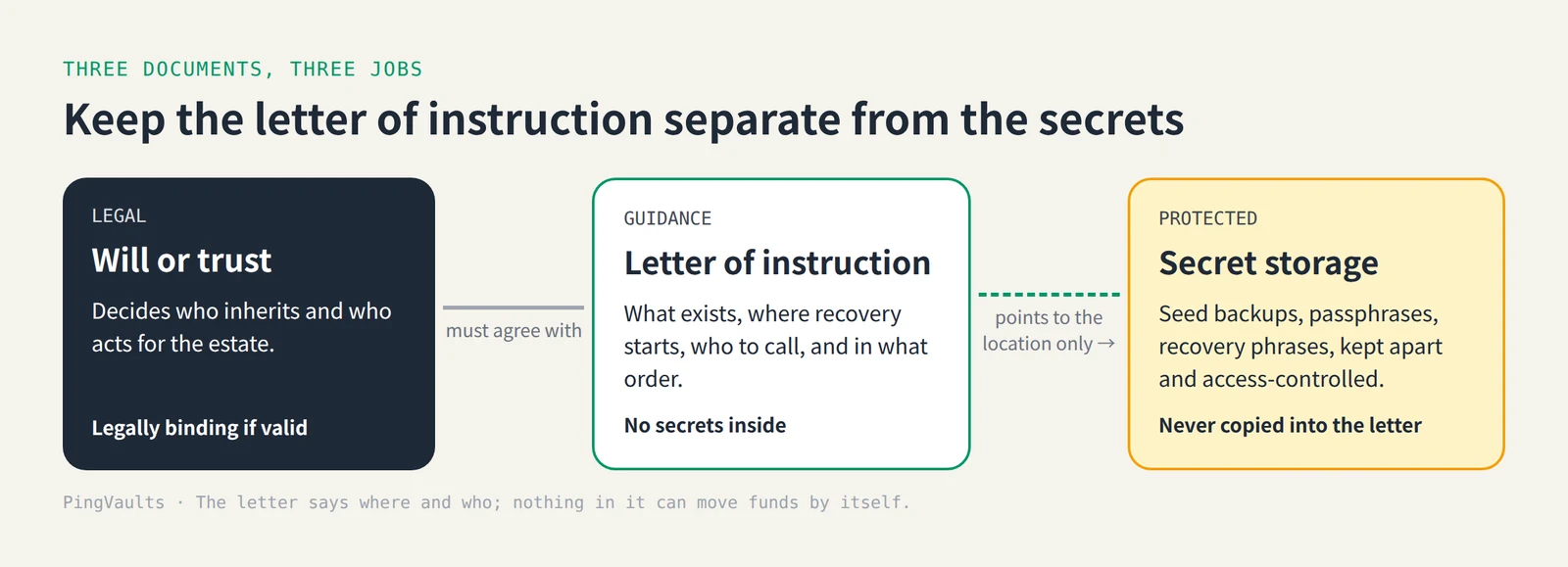
That distinction matters even more for crypto. Your will decides who inherits (see how to leave crypto in a will). The letter explains how someone with authority can actually find and reach what you own. A crypto letter can also be updated whenever you change a wallet, without redoing legal documents.
| Document | Its job | Legally binding? | Contains secrets? |
|---|---|---|---|
| Will or trust | Decides who inherits and who acts for the estate | Yes, if valid | No |
| Letter of instruction | Explains what exists, where to start, and in what order | No | No |
| Digital asset inventory | Lists each asset and its recovery route in detail | No | No |
| Protected secret storage | Holds seed backups and recovery phrases | No | Yes, kept separate |
The one rule: point to secrets, never contain them
General estate guides sometimes suggest listing usernames and passwords in the letter. For crypto, don't. Anyone who reads a seed phrase or private key can take the assets, with no bank to reverse it. A letter gets copied, scanned, and handed to advisers, and every copy is a risk.
Write where the route starts and what is needed, not the secret itself. "The Bitcoin wallet backup is in the fireproof box described in section 3. It also needs a passphrase held by my brother" is useful. The 24 words are not.
What to include
Work through these sections. Leave out any that don't apply.
- Purpose and date. One sentence saying what the letter is for, the date, and a note that newer versions replace it.
- Who to contact first. Your executor, a trusted technical helper, and your estate lawyer, each with an alternate. Explain each person's role.
- What exists. A short overview by type, such as "two exchange accounts, one hardware wallet, one wallet app." Refer to your inventory for details.
- Exchange accounts. The exchange name, the email linked to it, and a note that the estate should use the exchange's deceased-customer process. Coinbase and Kraken, for example, don't offer beneficiary designations.
- Self-custody wallets. The device or app, the network, where the backup is kept, and whether a passphrase or second signer is needed. Name the factor, but don't write it.
- Order of actions. What to do first, and what to avoid. For example: "Don't guess the device PIN. Ledger devices reset after three wrong attempts."
- Where other documents are. The will, the inventory, your tax records, and any encrypted vault or offline export.
- Things to ignore. A warning that no real helper will ask for seed words or charge a fee to "recover" funds, with a link to a scam checklist.
- Review log. When you last checked the letter and what changed.
Free template
Download the letter of instruction template as Word (DOCX), ready to fill in and print, or as plain text (TXT) for any text editor. Both are blank outlines, with no sign-up. Fill it in privately and print it or store it encrypted.
CRYPTO LETTER OF INSTRUCTION
Version date: ____  (replaces all earlier versions)

1. Purpose
This letter explains how my executor can find and recover my crypto
assets. It does not decide who inherits; see my will.
It contains no passwords, seed phrases, or private keys.

2. Who to contact first
Executor: ____        Alternate: ____
Technical helper: ____  Alternate: ____
Estate lawyer: ____

3. What exists (details in my inventory, ref ____)
Exchange accounts: ____
Self-custody wallets: ____

4. Exchange accounts
Exchange / linked email / where statements are kept: ____
Use the exchange's official deceased-customer process.

5. Self-custody wallets
Device or app / network / backup location / extra factor needed: ____

6. Order of actions
First: ____   Avoid: ____

7. Where other documents are: ____
8. Ignore anyone who asks for seed words or an upfront fee.
9. Review log: ____
A worked example (fictional)
2. Who to contact first. My executor is Dana (sister). My technical helper is Sam (friend, understands hardware wallets), and Alex is the alternate. Dana decides; Sam only helps.
4. Exchange accounts. One Coinbase account under my personal email. The estate should use Coinbase's executor process. Statements are in the "Tax" folder.
5. Self-custody wallets. One Bitcoin hardware wallet in the home safe. Its metal backup is at the bank deposit box listed in my will. The wallet also uses a passphrase. Sam has half of the hint, and Dana has the other half.
6. Order of actions. Don't try the device PIN. Confirm Dana's authority first. Then Sam restores the wallet on a new device using the backup and passphrase, and sends a small test amount before anything else.
The example shows the pattern: every line says where and who, and nothing in it could move funds by itself.
Where to keep it, and how to test it
Keep at least two copies where the right people can find them, such as with your will or with your executor. Make sure the copies are protected from general view. An encrypted copy can live in PingVaults, which can deliver it to a trusted contact after missed check-ins. Keep a printed or exported copy as well, so your family doesn't depend on any single service.
Then test it. Give a harmless version, with fake account names and a test wallet, to your helper, and see whether they can follow it without asking you anything. Our recovery drill checklist shows how.
When to update the letter
Update the letter whenever you:
- open or close an exchange account,
- move to a new wallet or device,
- add a passphrase or change the backup location, or
- change your executor, helper, or lawyer.
Also re-read it once a year, even if nothing seems to have changed.
Common questions
What should a crypto letter of instruction include?
The date and purpose, who to contact first, what crypto exists (exchange accounts and wallets by name), where each recovery route starts, any extra factor needed such as a passphrase or second signer, the order of actions, where your will and inventory are, and a warning about recovery scams. Leave out seed phrases, private keys, passwords and one-time codes.
Does a letter of instruction need a lawyer or witnesses?
It is an informal document, so usually not. Your will and any documents that transfer assets do need to follow local law. Ask your estate lawyer to check that the letter doesn't contradict the will.
Can I put the letter inside my will?
It is better kept separate. A will may become public during probate in some places, and a separate letter is easier to update when your wallets change.
What if I don't want my family to know the amounts?
Leave balances out. The letter only needs to say that assets exist and where recovery starts. The estate can value them later.
Is a PingVaults vault the same as a letter of instruction?
No. PingVaults is one way to store an encrypted copy and deliver it after inactivity. The letter is the content, and it should also exist outside any single service.