The short answer
For most families, inheriting crypto does not create a tax bill on the day it is received. Tax usually arises only when someone later sells, swaps or spends the crypto, and even then it is measured from the value on the date of death, not from what the original owner paid.
This article explains the general U.S. and UK rules. It is not tax advice. Estates, trusts, state taxes and other countries all have their own rules, so check your situation with a qualified adviser.
United States: inheritance is not income
The IRS says inheritances are generally not taxable income for the person who receives them. What matters is what happens next. If the heir sells the inherited crypto for more than its basis, the difference is a taxable gain. If they sell for less, it is a loss.
The step-up in basis
For inherited property, the IRS says the heir's basis is generally the fair market value on the date of the decedent's death. An executor who files an estate tax return can instead elect the alternate valuation date. This is often called a "step-up" because the old purchase price is replaced. If the price fell, the basis can step down too.
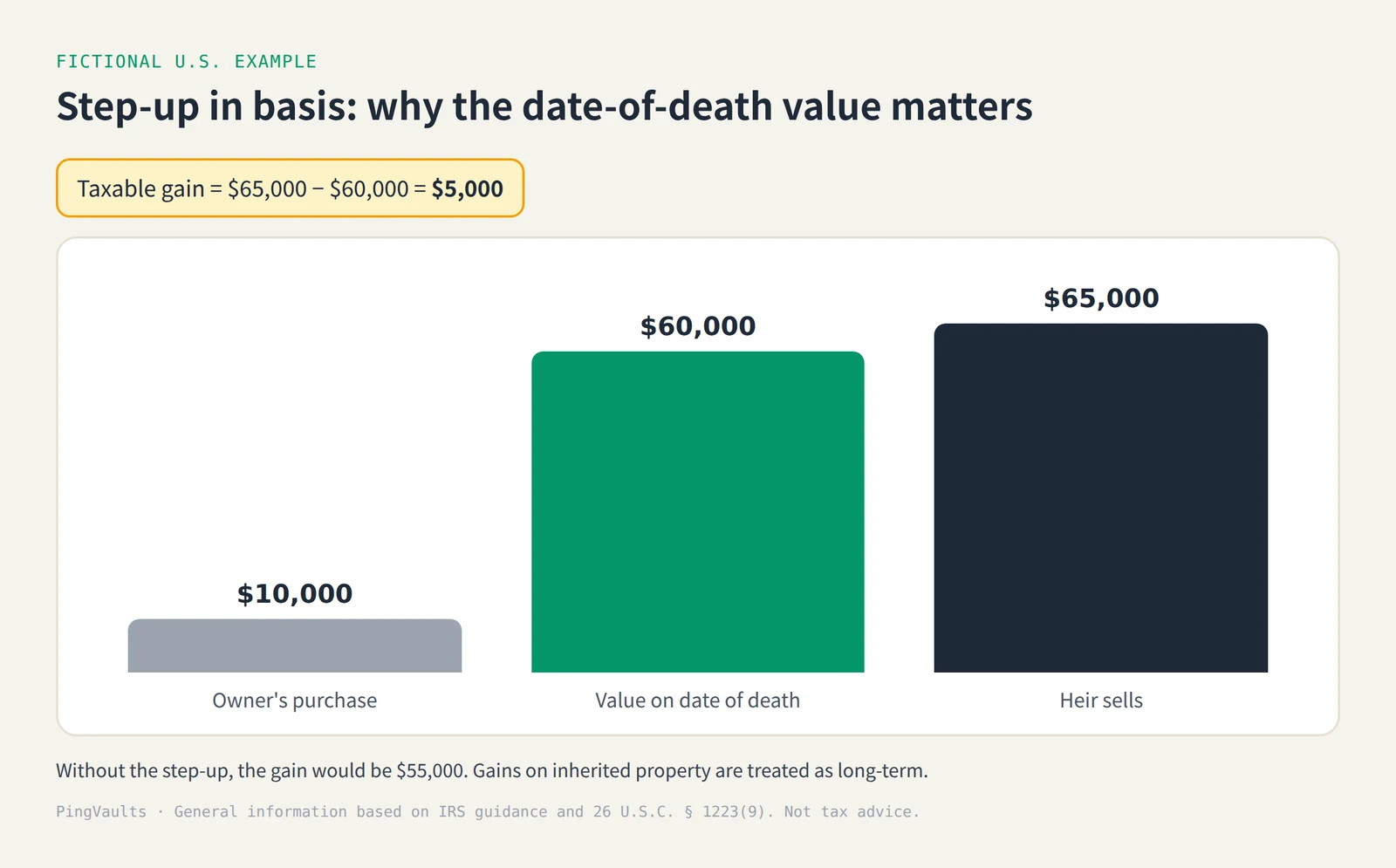
A fictional example:
| Step | Value | What it means |
|---|---|---|
| The owner bought bitcoin | $10,000 | The owner's cost no longer matters to the heir |
| Value on the date of death | $60,000 | This becomes the heir's basis |
| The heir sells | $65,000 | The sale price |
| Taxable gain | $5,000 | Sale price minus the date-of-death value |
Without the step-up, the gain would have been $55,000. That is why the date-of-death value is the most important number in the file.
Holding period: long-term, even if sold quickly
Federal law treats property acquired from a decedent as held for more than one year, even if the heir sells it within a year of the death (26 U.S.C. § 1223(9)). In practice, this means gains on inherited crypto are generally taxed at long-term capital gains rates.
When you report the sale, the Form 8949 instructions say to enter "INHERITED" in column (b) instead of a purchase date, and to report the disposition as long-term regardless of how long you held the property.
Federal estate tax is a separate question
Estate tax is charged on the estate itself, before anything passes to heirs, and only on large estates. The IRS lists the basic exclusion amount as $15,000,000 for people who die in 2026. Most families are far below that, but crypto still counts toward the total. A few states have their own estate or inheritance taxes with lower thresholds; see crypto inheritance tax by state.
How to record the date-of-death value
The step-up only helps if you can show the value. Record it early, before prices move and records get harder to find.
- Note the date and time zone of death. Crypto trades around the clock, so be consistent about which day's price you use.
- Get statements for custodial accounts. Ask exchanges and apps for a statement showing holdings and value on the date of death. See how to claim an exchange account and crypto in Cash App, PayPal, Venmo or Robinhood.
- Document self-custody wallets. Record the address or public key, the balance, and a reputable price source for that date. You can check a balance without the seed phrase, using the address alone.
- Save your sources. Keep screenshots or exports showing the price source, date and time.
- Give heirs a copy. Each heir needs the value of what they received, to report their own gain or loss later.
Watch the new broker forms
U.S. brokers must report gross proceeds for digital asset sales from 2025 on Form 1099-DA, and cost basis for certain sales from 2026. A broker may not know the stepped-up basis of crypto that was inherited or transferred in. If a 1099-DA shows no basis, or the old purchase price, use your own date-of-death records when you file, and keep them with your tax papers.
United Kingdom
HMRC treats crypto as part of a person's estate, like bank accounts or shares. The date-of-death value goes on the Inheritance Tax return. If the crypto can't be accessed, HMRC asks for an explanation and the value it's believed to have, in the additional information box of the IHT400.
For Capital Gains Tax, HMRC's helpsheet HS282 says there is no CGT charge when someone dies. Personal representatives and legatees are treated as acquiring the assets at their market value on the date of death. When a beneficiary later sells, their gain is measured from that value.
Can you use bitcoin to avoid inheritance or estate tax?
No. Holding wealth in bitcoin doesn't take it outside the estate.
- United States. Crypto counts toward the gross estate at its date-of-death value, like any other property. The step-up in basis reduces the heir's capital gains tax when they sell; it does nothing to federal estate tax, which is calculated on the estate before anything passes. Some states, New York among them, have their own estate tax with a much lower threshold than the federal one.
- United Kingdom. HMRC treats cryptoassets as part of the estate. Inheritance Tax is generally charged at 40% on the part of the estate above the £325,000 nil-rate band, and crypto gets no special relief. The CGT uplift to date-of-death value applies to the heirs, not to the Inheritance Tax bill.
Assets that nobody can reach because the recovery phrase is lost don't escape tax either: in the UK, HMRC still asks for them to be reported on the IHT400. What reduces these taxes is ordinary estate planning, such as lifetime gifts and trusts, set up with an adviser. A wallet nobody knows about only means your family may lose the assets.
If you hold crypto today
You can make this much easier for your family:
- Keep a simple record of what you hold, where, and roughly when you bought it, in a digital asset inventory.
- Make sure your family knows each exchange and wallet exists, through a letter of instruction.
- Don't rely on a single exchange's records. Export your transaction history once a year.
Common questions
Can you use bitcoin to avoid inheritance tax?
No. Crypto is part of the estate at its date-of-death value in both the U.S. and the UK. The step-up in basis lowers the heir's capital gains tax, not estate or Inheritance Tax.
Do I pay tax when I inherit bitcoin?
In the U.S., generally no. Receiving an inheritance is not income. Tax usually applies when you later sell or swap it, on the gain above the date-of-death value.
Do I pay tax when I sell inherited bitcoin?
Usually only on the gain since the date of death. A fictional example: your parent bought 0.5 BTC for $5,000. On the date of death it was worth $30,000, so that becomes your basis. If you sell it eight months later for $32,000, the taxable gain is $2,000, reported as long-term with "INHERITED" as the acquisition date on Form 8949. If you sell it for $28,000, you have a $2,000 capital loss instead. Keep the record of the date-of-death value, because it is the number the whole calculation depends on.
What if the crypto lost value after the death?
Your basis is still the date-of-death value, so selling below it usually creates a capital loss.
Does swapping inherited crypto for another coin count as a sale?
In the U.S., generally yes. Exchanging one crypto for another is treated as a disposal, so a gain or loss is calculated at that point.
Who reports the value, the executor or the heir?
Both may need it. The executor handles the estate's filings, and each heir needs the value of what they received to report their own later sale. Ask the executor for a written record of values.