Why payment-app crypto is different
Many people never touch a hardware wallet. They buy a little bitcoin in Cash App, or crypto in PayPal, Venmo or Robinhood, next to their everyday money. For the family, that is good news. The app holds the crypto for its customer, so it can be released through a normal estate process. PayPal's terms, for example, say that custody and trading services are performed for it by Paxos Trust Company.
It also means there is no seed phrase to look for. If you find one anyway, the person probably had a separate self-custody wallet as well. That wallet follows a different route, described in our 30-day family checklist.
The flip side is that you cannot simply log in. Using the owner's phone or password to sell or send crypto can breach the app's terms and complicate the estate. Each app below says it works with the family or the estate's representative, not with someone signing in as the deceased.
First, find out which apps were used
Look for these clues before contacting anyone:
- App icons on the person's phone, and app-store purchase history
- Emails from Cash App, PayPal, Venmo or Robinhood, including monthly statements
- Bank or card transfers to these apps
- Tax forms from the apps. Brokers began issuing Form 1099-DA for digital asset sales made from 2025 onward.
- A $Cashtag, phone number or email the person used for payments
Write each clue on one list, without passwords or codes. A digital asset inventory, if the person kept one, may already have this.
Cash App
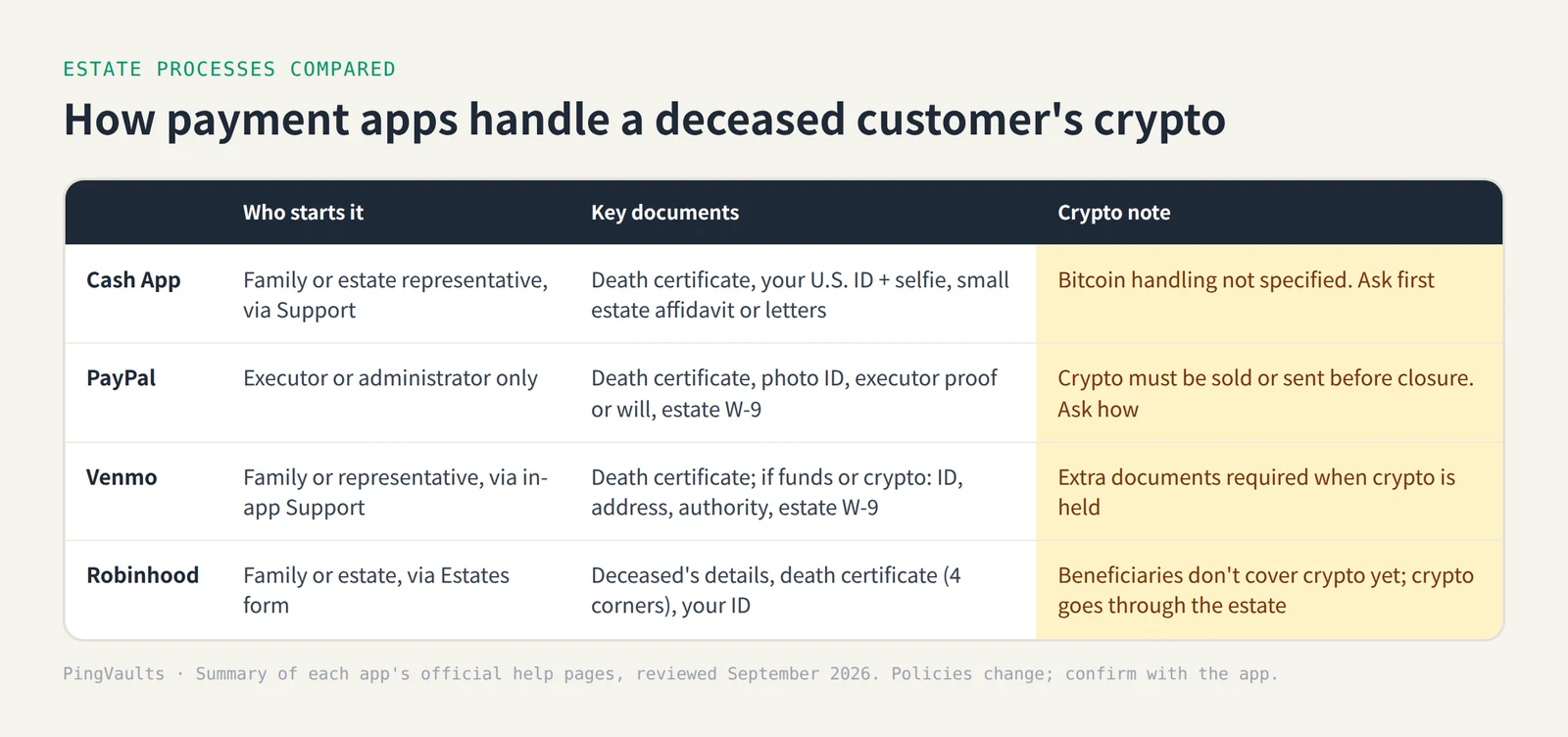
Cash App's deceased customer estate services page says that each state has different rules for how a decedent's funds can be paid out, and that it may ask for:
- a death certificate
- the deceased's full legal name, and any $Cashtag, phone numbers or email addresses linked to the account
- your own details and relationship to the deceased
- front and back photos of your U.S. ID, plus a selfie holding it
- a small estate affidavit or equivalent document, or letters appointing an executor or administrator
To start, call Cash App Support. The page doesn't say whether bitcoin in the account is sent as bitcoin or sold first, so ask before you submit your documents. Step-by-step, including Cash App Investing beneficiaries and Bitkey: Cash App deceased account guide.
PayPal
PayPal says only the executor or administrator of the estate can request the closure of a deceased relative's account. It asks for a cover sheet, the requester's email address, a copy of the death certificate, the requester's photo ID, proof of executor status or a copy of the will (or state documentation if there is no will), and an IRS Form W-9 for the estate.
Documents go to deceasedaccounts@paypal.com, or by post to PayPal's address on its help page. PayPal says approved funds are paid as a check in the deceased's name, or to the linked bank account if you can access it. Its help page doesn't describe crypto separately, and its crypto terms say crypto must be sold or transferred before a customer closes an account. Ask PayPal how it will handle the crypto balance. The step-by-step version is in our PayPal deceased account guide.
Venmo
Venmo says a death certificate is enough to close an account. If there is money or crypto in the account, it also asks for the requester's photo ID, proof of address, documents showing executor or administrator authority, and an IRS Form W-9 for the estate. Start through Venmo Support in the app or on its contact page. Venmo asks you to upload documents through the secure link an agent sends, not by email. It says it cannot give anyone access to the account or transfer its ownership. Step by step, including the Venmo Credit Card: Venmo deceased account.
Robinhood
Robinhood's Estates form asks for the deceased's name, Social Security number, dates of birth and death, a copy of the death certificate showing all four corners, and your photo ID. An estate representative then contacts you. Robinhood asks families not to send wills or trusts unless it requests them later.
Robinhood lets customers name beneficiaries on individual investing accounts, IRAs and some other account types. Its beneficiaries page says crypto is not included yet: until it is, "any crypto assets will be distributed as a part of your estate." So stocks may pass directly to a named beneficiary, while crypto in the same app goes through the estate. Step-by-step, including TOD rules and Robinhood Wallet: Robinhood Estates form and death claim guide.
Questions to ask before you send documents
Ask each app in writing, and keep the replies in your records:
- Will the crypto be transferred as crypto, or sold and paid out as cash?
- If sold, on which date and at what price?
- Can the value on the date of death be confirmed in a statement?
- Which authority document does the app accept in your state: a small estate affidavit, letters testamentary, or letters of administration?
- Where should funds or crypto be sent: an estate bank account, a beneficiary's account, or a check?
The answers matter for tax. In the U.S., an heir's cost basis is generally the value on the date of death, so a sale by the app later can create a gain or loss. See how inherited crypto is taxed.
Watch for fake support
Families searching for "Cash App support number" or "PayPal deceased account phone number" are a common target for impostors. Use only the contact route inside the official app or on the company's own help site. No real support agent will ask for a PIN, a login code, remote access to your computer, or a fee to release an estate. Our recovery-scam checklist lists the usual tactics.
If you hold crypto in one of these apps
A few small steps now will save your family weeks later:
- List each app, and the phone number or email tied to it, in your inventory or letter of instruction.
- If you use Robinhood, name beneficiaries for your investing account, and remember that crypto still goes through your estate.
- Keep your legal name and address current in each app, so they match your estate documents.
- For larger amounts, consider whether a payment app is the right long-term home, or whether a dedicated exchange or self-custody with tested instructions suits you better.
Common questions
Is there a seed phrase for Cash App bitcoin?
Not for bitcoin kept in the Cash App balance. Cash App holds it for the customer. A seed phrase only exists if the person moved bitcoin out to a separate self-custody wallet.
Can I just use their phone to cash out?
Don't. It can breach the app's terms, freeze the account, and create problems for the estate. Use the app's estate process.
Do we need probate?
Not always. Cash App says a small estate affidavit, where a state offers one, can be used instead of formal probate. Larger estates usually need letters from a probate court. Ask a local lawyer which applies.
Will the app send crypto to my own wallet?
The help pages above don't promise that. Some apps may only pay out cash. Ask the app directly, and record the answer.