First, confirm it really is an exchange account
The word "crypto" covers two very different situations, and they are recovered in different ways.
An exchange or custodial account is held by a company such as Coinbase, Kraken, or Binance. The company controls the keys and keeps customer records, so the assets are released through a documented claim, much like a brokerage account.
A self-custody wallet is controlled by whoever holds its seed phrase or signing keys. No company can release it, and no claim form exists. If you found a hardware wallet or a paper backup rather than an account email, start with our family checklist for the first 30 days and the bitcoin inheritance guide instead. For an overview of every route, see what happens to bitcoin and crypto when someone dies.
| Clue you found | Likely situation | Where recovery starts |
|---|---|---|
| Emails or statements from an exchange, a tax form listing an exchange | Exchange account | The exchange's deceased-customer process |
| A hardware wallet, a metal or paper backup with 12–24 words | Self-custody wallet | The owner's recovery instructions and a trusted technical helper |
| Bank transfers to an exchange, but no other records | Probably an exchange account | Contact the exchange with the documents below |
| Both | Mixed | Handle each item on its own route; list them in an inventory |
Do not log in with the owner's password
Families often find a password or a phone that still receives two-factor codes. Using them to sign in as the deceased person is usually a breach of the exchange's terms. It can also freeze the account when the exchange later learns of the death, and it creates a record that is hard to explain to the estate's lawyer or tax adviser.
Keep the owner's phone, email account, and phone number active and secure for now. The exchange may send verification messages to them during the claim, and closing them early can remove the only link between the account and the owner.
What exchanges usually ask for
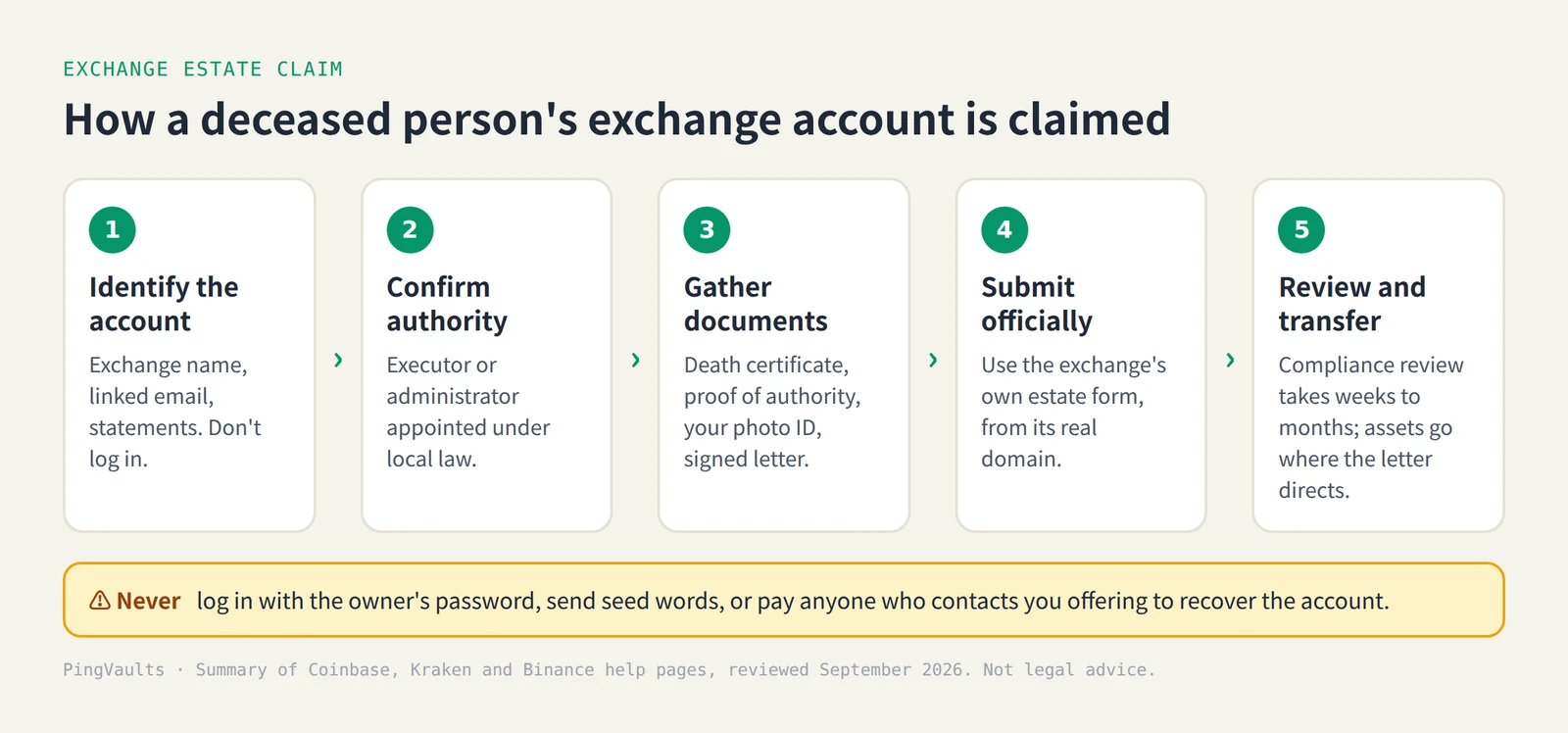
Requirements vary by exchange and jurisdiction, but the published processes share a common core.
| Document | What it proves | Notes |
|---|---|---|
| Death certificate | The account holder has died | Kraken asks for a color image and says funeral home certificates are not accepted |
| Proof of authority | You may act for the estate | Probate, letters testamentary, letters of administration, or a small-estate affidavit, depending on jurisdiction |
| Your government photo ID | Who is making the claim | Must match the name on the authority document |
| Signed instruction letter | What the exchange should do | For example, transfer to a named account; Coinbase asks for a letter naming the destination account and email |
| Your own account at that exchange | Where assets can be moved | Coinbase and Binance ask the claimant to sign in to or create an account first |
The person who submits is normally the executor or administrator, not simply the closest relative. If no one has been appointed yet, ask a local estate lawyer which document applies. In many places a small estate has a simpler procedure.
How the major exchanges handle claims (September 2026)
The details below summarize each exchange's official help page as of the review date. Policies change, so always open the page yourself from the exchange's own domain before sending documents.
Coinbase. The claim is made through Coinbase's Executor Services form after the claimant signs in to or creates a Coinbase account. Coinbase lists a death certificate; probate or letters testamentary, letters of administration, or a small-estate affidavit; a current photo ID for each named person; and a signed letter directing where the assets should go. Coinbase says it does not currently support naming a beneficiary on individual accounts. Our Coinbase deceased account guide covers the form and the instructions letter in more detail.
Coinbase Executor Services form: what to have ready
- Your own Coinbase account, signed in. The form is submitted from the claimant's account, not the deceased's.
- A scan of the death certificate.
- Proof that you have authority over the estate: probate, letters testamentary, letters of administration, or a small-estate affidavit.
- A current photo ID for each person named in those documents.
- A signed letter saying where the assets should go.
Keep the names and spellings identical across every document; mismatches are a common reason claims stall.
Kraken. A legal representative of the estate submits Kraken's deceased client claim form with a color death certificate, proof of appointment, their photo ID, and a signed letter confirming the death. Kraken's compliance team reviews the claim and may ask for more documents. Kraken says it does not offer beneficiaries on accounts. Step-by-step: claiming a Kraken account after a death.
Binance. Family members use the Inheritance Appeal (listed as Legacy Inheritance under Account in Binance's self-service support area) from their own Binance account. The applicant identifies the deceased user by email, phone number, or Binance ID and uploads legally valid inheritance documents. Binance says reviews typically take one to two months, and longer for complex cases. Step-by-step: the Binance Inheritance Appeal.
Binance.US. Binance.US asks for a selfie video stating the preferred transfer method, a death certificate, the ID of the person in the video, and probate or equivalent documents. You then ask its support team to open the case.
Gemini. Gemini's help center says it does not offer beneficiary designations and suggests planning with an estate attorney. Contact Gemini support from its official site to start an estate claim. Step-by-step: starting a Gemini death claim.
Crypto.com. Crypto.com has not published a deceased-customer procedure. Its app terms direct customers to live in-app chat or chat.crypto.com, so the estate starts there and asks for the process. Its Onchain wallet (formerly the DeFi Wallet) is self-custody and can only be restored with the recovery phrase. Step-by-step: starting a Crypto.com claim after a death.
Robinhood. The family starts with the Robinhood Estates form: the deceased's details, a four-corner photo of the death certificate and the claimant's ID. Named TOD beneficiaries can receive stocks, but Robinhood says crypto is distributed as part of the estate.
If the crypto was bought inside a payment app rather than an exchange, see Cash App bitcoin after a death or crypto in PayPal, Venmo and other payment apps.
For another exchange, search its help center for "deceased," "estate," or "inheritance." If nothing is published, write to official support and ask for its estate procedure before sending any documents.
How long each exchange takes
Only Binance publishes an estimate. The others review case by case, so treat any figure you see elsewhere as anecdotal.
| Exchange | Published timeline | What moves it along |
|---|---|---|
| Coinbase | None published | Reply to the Executor Services ticket from the same email; send every document in one batch |
| Kraken | None published | Answer compliance requests for extra documents quickly |
| Binance | "Usually around 1–2 months", longer for complex cases | Make sure the inheritance documents are legally valid where they were issued |
| Binance.US | None published | Record the selfie video exactly as described before contacting support |
| Gemini | None published | Start from Gemini's official support site and keep the ticket number |
| Crypto.com | No published estate process | Ask in-app chat or chat.crypto.com for the procedure first |
In every case the clock effectively starts when the exchange has a complete, consistent set of documents. A missing page or a name mismatch usually restarts the wait.
Why claims stall, and how to keep one moving
Most delays come from mismatches. Find and fix them before you submit.
- Names don't match. The name on the death certificate, the authority document, and the exchange account may differ because of a middle name, a transliteration, or a name change. Include documents that link them.
- Wrong or missing authority. A will alone is often not enough. Exchanges want proof that a court or official process has appointed you, or a document that local law accepts in its place.
- Several jurisdictions. The owner may have lived in one country and used an exchange entity registered in another. Ask the exchange which entity holds the account and which documents it accepts.
- Unknown account email. Search the owner's email and bank statements for the exchange's name. Exchanges can often find an account by email, phone number, or user ID.
- Unreadable scans. Send clear color copies that show every page, and keep a log of what you sent and when.
Keep a single written log of every submission, ticket number, and reply. It saves time if the case is reassigned or the estate adviser needs a record.
Values, taxes, and conversion
Ask the estate's adviser whether you need a record of each asset's value on the date of death. Taking a screenshot or statement early is easier than rebuilding one later. Exchanges may transfer the assets, or they may require conversion or a payment to a bank account. Ask before you accept either, because the method can matter for tax and for how the estate is distributed. For how heirs are taxed when they later sell, see is inherited crypto taxable? This article is general information, not legal or tax advice.
Watch for impostors
A public notice of death can attract fake "recovery agents," fake exchange staff, and fake law firms. The FBI's Internet Crime Complaint Center has warned about companies that falsely claim they can recover crypto for an upfront fee. A real exchange will not ask for a seed phrase, remote access to a computer, or a fee to release an estate account. Reach the exchange only through the address you typed yourself. Our recovery-scam checklist for families lists the most common red flags, and our guide to crypto wallet support numbers shows which companies have phone support at all.
If you are the account holder: make this easier for your family
Most exchanges don't let you name a beneficiary, so your family will need the estate route. You can still shorten it:
- List every exchange you use, and the email linked to each, in a digital asset inventory.
- Say in your will or a letter of instruction that these accounts exist, without writing down passwords.
- Keep your identity details on each exchange current, so the names match your legal documents.
- Decide whether assets you actively manage should stay on an exchange or move to self-custody with tested recovery instructions.
PingVaults can deliver an encrypted note to a trusted contact after a period of inactivity, the way a dead man's switch works. Use it to tell them which exchanges to contact and where your estate documents are. It does not replace the exchange's claim process or prove authority. To plan for wallets as well as exchange accounts, see how to build a crypto inheritance plan.
Common questions
Can a family member withdraw funds without probate?
Usually not directly. Some jurisdictions accept a small-estate affidavit or similar document in place of full probate, and Coinbase names this among its accepted documents. Ask a local lawyer which applies before contacting the exchange.
How long does an exchange estate claim take?
Binance says one to two months is typical. Other exchanges don't publish a timeline. Complete, consistent documents are the biggest factor you control.
How long does Coinbase take to release a deceased person's account?
Coinbase does not publish a processing time. Its Executor Services team reviews each claim, and it can go back and forth if a document is missing or names don't match. The only official benchmark from a major exchange is Binance's one to two months. To avoid delays, submit the death certificate, proof of authority, photo ID for each named person, and the signed instruction letter together, and answer follow-up emails from the same address.
Will the exchange send crypto or cash?
It depends on the exchange, the jurisdiction, and the instruction letter. Some transfer the assets to the claimant's account at the same exchange. Ask the exchange before you submit your letter.
What if we can't tell which exchanges were used?
Look for emails, app icons, two-factor apps, bank or card transfers, and tax forms. Then contact each likely exchange's estate process. Many exchanges can confirm whether an account exists once you've shown authority. See how to find out if a deceased person had crypto for where to look.