Why the first days matter
When someone who held crypto dies, the usual advice to "sort out the finances" can go badly wrong. A well-meaning relative can guess a PIN until a hardware wallet wipes itself, cancel the phone number that receives two-factor codes, or reply to a stranger offering to "recover" the assets.
Most of the harm in the first month comes from rushed actions, not from waiting. This checklist puts things in a safe order. It is general information, not legal advice, and it does not replace the steps your country requires after a death, such as registering it and applying for probate. GOV.UK and USAGov publish those official checklists.
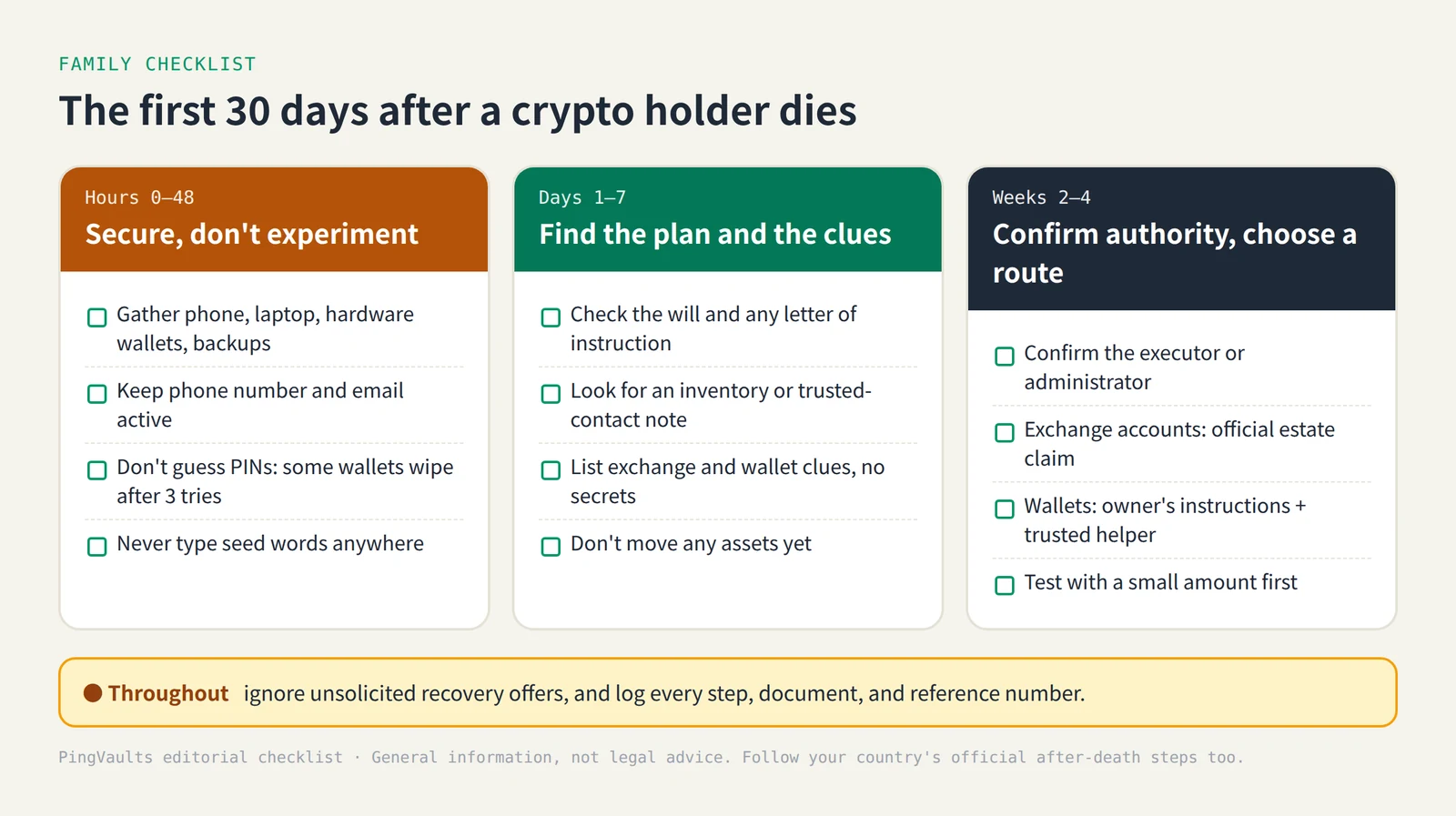
Hours 0–48: secure, don't experiment
The goal is to keep everything exactly as it is and out of the wrong hands.
- Gather the devices. Put the phone, laptop, tablets, hardware wallets, and any notebooks or metal plates in one safe, private place. Write down where each item was found.
- Keep the phone and email alive. Charge the phone and keep paying for the number and the email account. Exchanges and wallets may send verification codes to them, and authenticator apps live on the phone.
- Don't guess PINs. A Ledger device factory-resets after three wrong PIN attempts. Current Trezor models erase the wallet after 10 or 16 wrong attempts, depending on the model. After a reset, only the backup can restore the wallet.
- Never type seed words anywhere. Don't enter recovery words into a website, an app, a chat, or a support form. No legitimate service needs them to help you, and most wallet makers have no phone support at all; see which crypto wallet support numbers are real.
- Don't reset or update devices. A factory reset or a forced update can remove the evidence and apps you need later.
- Limit who knows. Tell only the people who need to know that crypto may be involved. Don't mention it in a public obituary or on social media.
Days 1–7: find the plan and the clues
Many owners leave a map. Look for it before you work anything out yourself.
- Look for a plan. Check the will and any letter of instruction for crypto notes. Look for a digital asset inventory, a message from a service such as PingVaults, or a note naming a trusted contact or adviser.
- Collect clues without logging in. Note exchange names in email subjects and bank or card statements, tax forms that list crypto, app icons on the phone, authenticator entries, hardware wallet brands, and backup cards. Where to look for a deceased person's crypto goes through each place.
- Write one list. Record each clue with where it was found. Don't write any secret on it, such as a password or seed word.
- Don't move anything yet. Knowing that an account exists is enough for now.
Weeks 2–4: confirm authority, then choose a route
Before anyone acts on the assets, the family needs to know who is legally allowed to. Usually that is an executor named in the will, or an administrator appointed by a court or official process. Check with a local estate lawyer.
Then sort every item into one of three routes.
| Route | How to recognise it | What to do |
|---|---|---|
| Exchange or custodial account | Statements, emails, or an app from a company such as Coinbase or Kraken | The person with authority uses the exchange's deceased-customer process. See how to claim an exchange account. |
| Self-custody wallet | A hardware wallet, a seed backup, or a wallet app | Follow the owner's written instructions with a trusted helper, only once authority is clear. Test with a small amount before moving more. |
| Unknown | A clue with no clear owner or provider | Keep it on the list. Ask the estate adviser before contacting anyone. |
For self-custody wallets, the owner's instructions may mention a PIN, a seed phrase, a passphrase, or a second signer. Our guide to PINs, seed phrases, and passphrases explains what each one does, so the family doesn't mix them up.
Throughout: treat unsolicited help as a red flag
Death notices attract scammers. Be suspicious of anyone who contacts you first offering to recover crypto, especially if they ask for a fee, a seed phrase, or remote access to a computer. The FBI has warned about fake recovery companies that charge upfront fees and claim to work with law enforcement. Find helpers through people you trust or an estate lawyer, and check them on your own. Our recovery-scam checklist covers the warning signs in more detail.
Keep a record of every step
A simple log protects the family and helps the executor. Include the date, who did what, which documents were sent to whom, and any reference numbers. Ask the estate's adviser whether you also need each asset's value on the date of death. It is easier to record early than to rebuild later.
Do and don't at a glance
| Do | Don't |
|---|---|
| Keep devices charged, together, and private | Guess PINs or passwords |
| Keep the phone number and email account active | Close accounts the recovery may depend on |
| Look for a plan, inventory, or trusted contact | Type seed words into any site, app, or form |
| Confirm who has legal authority | Log in to exchanges as the deceased person |
| Contact exchanges through their official sites | Reply to strangers offering to recover funds |
| Log every step | Post about crypto in public notices |
If you hold crypto today
The kindest thing you can do for your family is to make this checklist unnecessary. Write down which exchanges and wallets exist, where the instructions start, and who your trusted contact is. Keep the secrets themselves stored separately. Then run a recovery drill with harmless test data.
A letter of instruction is a good place to start. PingVaults can deliver an encrypted version of it to a trusted contact after missed check-ins. It cannot confirm a death or grant legal authority.
Common questions
Should we unplug the computer or turn off the phone?
Keep them in a safe place and charged. The aim is not to erase or lock anything by accident. If a device asks for a PIN you don't know, stop and write down what it says.
We found a seed phrase. Can we check the balance?
Wait until authority is clear and you have the owner's instructions or an adviser you trust. Entering a seed phrase into an unknown app or website can expose the funds to theft.
How long before we need to act?
Crypto doesn't expire on a deadline in the first month. Exchange claims and court steps take weeks to months. Moving slowly and in the right order is safer than moving fast.
Is a PingVaults notification proof that the person has died?
No. It only shows that check-ins were missed. Legal processes need official documents, such as a death certificate and proof of authority.