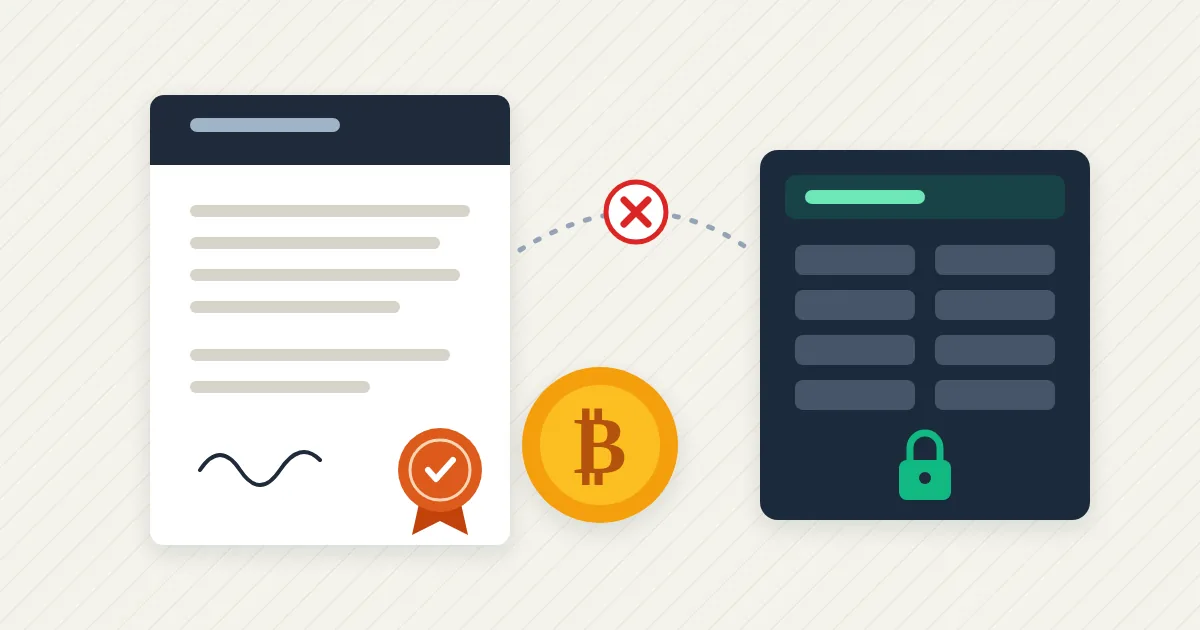
The short answer
Yes, you can leave crypto in a will. In most legal systems it is property like anything else, and England and Wales confirmed this in statute with the Property (Digital Assets etc) Act 2025. What makes crypto different is access. A will can say who inherits your bitcoin, but it can't make anyone able to move it.
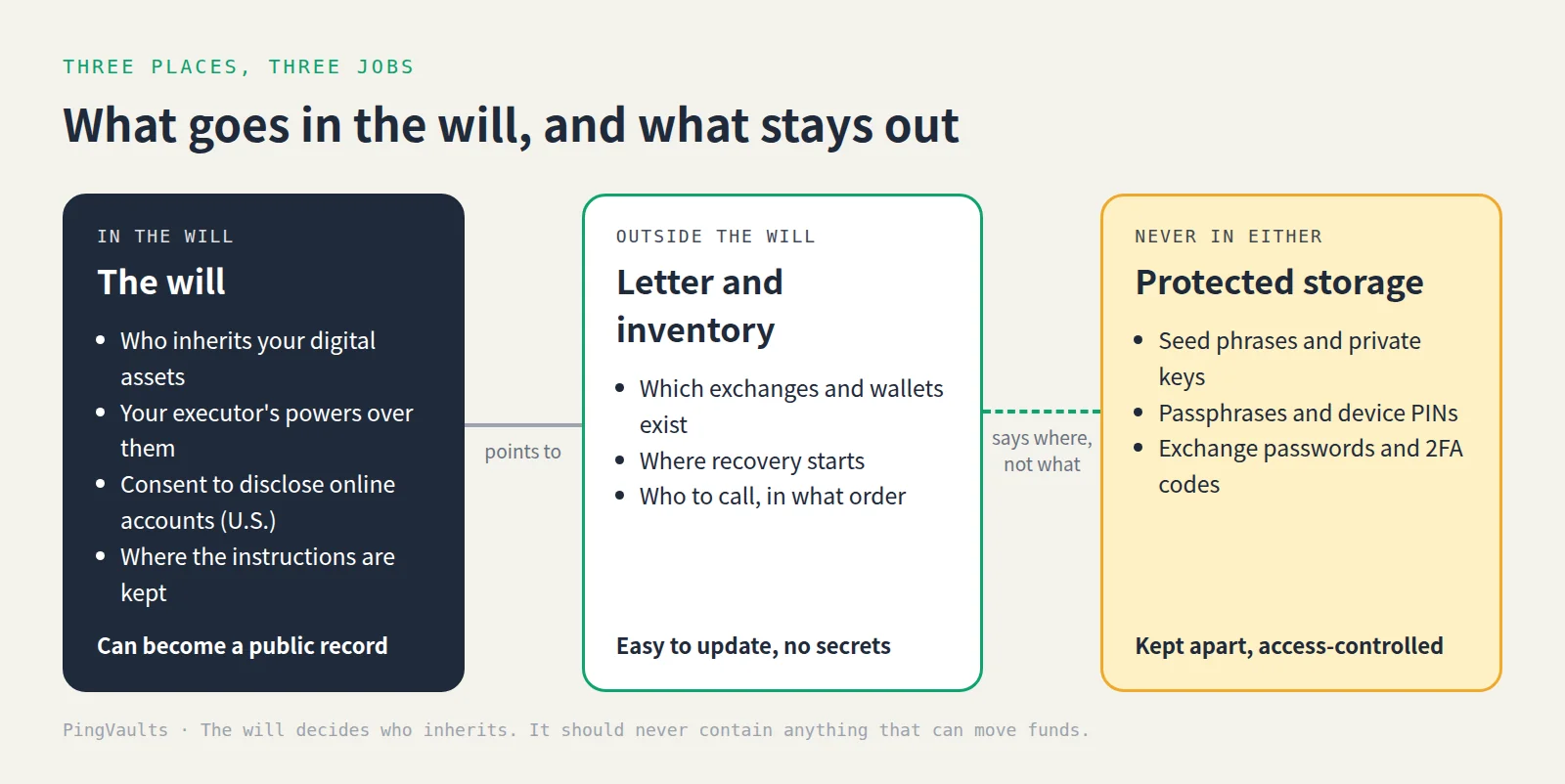
So a crypto-ready estate plan has three parts:
- The will says who inherits and who is in charge.
- A letter of instruction and an inventory say what exists and where recovery starts.
- Protected storage holds the seed backups and passphrases, and the will never repeats them.
Never put a seed phrase, key or password in a will
This is the rule that matters most. Anyone who reads a recovery phrase or private key can take the funds, and no bank can reverse it. A will is a poor place for a secret:
- It can become public. A superior court clerk in Washington State puts it plainly: "Wills that are filed after the death of a testator are public record" (Snohomish County). In England and Wales, a will attached to a grant of probate can be ordered by anyone through GOV.UK's probate search.
- It gets copied. Drafts go to lawyers, witnesses see it, and executors send copies to banks and exchanges.
- It is slow to change. You may move wallets several times; updating a will each time is costly and easy to forget.
Write in the will that the assets exist and who gets them. Write the route elsewhere, and keep the secrets out of both.
What to write in the will
These are the points to raise with your estate lawyer. The wording below is illustrative, to help you explain what you want. It is not a clause to copy, and the right drafting depends on where you live.
| Topic | Why it matters for crypto | Plain-language example to discuss |
|---|---|---|
| A broad definition of digital assets | Makes sure crypto, exchange accounts and wallets are clearly covered | "My digital assets, including cryptocurrency held in any exchange account or self-custody wallet" |
| Who inherits | Decides the split, the same as for other property | "Divided equally between my children" rather than "0.5 BTC to Sam" |
| Executor powers | Lets the executor deal with exchanges, hire a technical helper and convert or transfer assets | "My executor may access, manage, transfer or sell my digital assets and may engage a technical adviser" |
| Consent to disclosure of accounts | In many U.S. states, lets custodians show your executor the contents of online accounts | "I consent to the disclosure of the content of my electronic communications and digital assets to my executor" |
| A pointer, not the route | Tells the executor where the practical instructions are | "Instructions for locating my digital assets are kept with my letter of instruction" |
Percentages usually age better than coin amounts
Crypto prices and holdings change. A gift of "2 ETH to my nephew" can end up worth far more or less than you intended, or fail if you no longer hold that coin. Many people prefer shares of the digital assets, or of the whole estate. Ask your lawyer how your jurisdiction treats a specific gift of something you've sold or swapped.
Consent to disclosure (United States)
Most U.S. states have adopted a version of the Revised Uniform Fiduciary Access to Digital Assets Act (RUFADAA). Under the model act, a user "may allow or prohibit in a will, trust, power of attorney, or other record, disclosure to a fiduciary" of their digital assets. An instruction given through a provider's own online tool overrides a contrary will, and both override the provider's standard terms of service.
The act is about access to records, such as emails and account statements, which help an executor find exchange accounts. It does not give anyone your private keys, and it doesn't replace an exchange's claim process.
Exchange accounts vs self-custody wallets
The will covers both, but they pass in different ways.
Exchange accounts. Coinbase, Kraken and Gemini don't let you name a beneficiary on an individual account, so your executor claims the account with a death certificate and proof of authority. Your will is what names that executor. Our guide to claiming an exchange account after a death lists what each exchange asks for.
Self-custody wallets. No company can release these. Whoever has the recovery phrase and any passphrase controls the coins, whatever the will says. Your executor needs a safe route to those secrets, which is why the letter of instruction and protected storage matter as much as the will. See our guide to hardware wallets after a death.
Payment and brokerage apps. A transfer-on-death beneficiary on an app like Robinhood may not cover the crypto in it. See the Robinhood estates guide.
Choose an executor who can handle it
Your executor doesn't need to be a crypto expert, but they must be able to follow instructions carefully and resist scammers. Many people name a trusted executor and, separately, a technical helper who has no authority of their own. Tell both of them that the plan exists. Our guide to choosing a crypto inheritance contact covers the trade-offs.
Trusts and other options
In the U.S., a revocable living trust can hold assets outside probate, which keeps them out of the public court file and can speed up transfer. The same access problem applies: the trustee still needs the recovery route. A lawyer can tell you whether a trust is worth it for the size and type of your holdings.
If you have no will, your crypto still passes under the default inheritance rules where you live. Your family still needs to find it and reach it, and the process usually takes longer without a named executor.
Checklist before you sign
- List every exchange account and wallet in a digital asset inventory, without secrets.
- Ask your lawyer to cover digital assets expressly, including executor powers and, in the U.S., consent to disclosure.
- Prefer shares over fixed coin amounts, unless you have a clear reason.
- Write a letter of instruction that says where recovery starts and who to call.
- Store seed backups and passphrases separately, and make sure someone you trust can reach them when needed.
- Keep identity details on each exchange current so they match your legal name.
- Run a recovery drill with a test wallet.
- Review the plan whenever you open, close or move an account, and at least once a year.
Where PingVaults fits
PingVaults stores an encrypted note, such as your letter of instruction or recovery pointers, and delivers it to a trusted contact if you stop checking in. It is not a will, it doesn't decide who inherits, and it doesn't prove anyone's legal authority. Use it alongside a valid will, and keep an offline copy so your family doesn't depend on any single service.
This article is general information, not legal or tax advice. For how heirs are taxed when they sell, see is inherited crypto taxable? Some states also charge estate or inheritance tax; see crypto inheritance tax by state.
Common questions
Can I write my seed phrase in my will?
You shouldn't. Wills are shared with advisers and can become public records after death, and anyone who sees a seed phrase can take the funds. Put a pointer in the will or letter, and keep the phrase in protected storage.
Do I need to list every coin in my will?
Usually not. A broad clause covering all digital assets, plus an inventory kept outside the will, is easier to keep current. Your inventory can list the details.
Is a letter of instruction legally binding?
No. It explains how to find and reach assets. Only a valid will, trust or other legal document decides who inherits.
Can I name a beneficiary on my exchange account instead?
Most major exchanges don't offer it. Coinbase, Kraken and Gemini say they don't support beneficiary designations for individual accounts, so the will and executor route is how those accounts pass.
What happens to crypto if there is no will?
It passes under the default inheritance rules where the owner lived, like other property. Someone still has to be appointed to deal with the estate, and they still need a way to reach self-custody wallets.